
A place logo carries several meanings effectively when one clear shape works at first glance and secondary references reward closer attention. Prioritize a recognizable silhouette, relevant local meaning, and performance at small sizes. A concept explanation can enrich the mark, but should not be required to identify or use it.
Choose what people should see first
A place has landscapes, history, communities, architecture, and everyday life. Trying to represent all of them in one logo usually produces a complicated explanation. Start with the main reading: what shape should a person recognize before they know the design story?
The Australian Olympic Committee: Brisbane 2032 emblems says the Olympic and Paralympic emblems draw on Queensland and Australian identity, with two native cockatoos at their heart. That is an attributed description of the project. It gives a useful prompt for designers: a specific local reference can anchor a symbol while a broader identity carries additional stories.
Give each meaning a different job
The primary shape supports recognition. A secondary reading can connect it to a name, landscape, activity, or local narrative. Additional stories may belong in imagery, patterns, writing, and applications. They do not all need to be hidden in the same outline.
For a fictional riverside cultural venue, a main form could suggest a gathering place, with negative space hinting at a river bend. The history of its building might be better expressed through photography and editorial content. Keeping those roles separate leaves the logo easier to reproduce.
Check local relevance before visual cleverness
Ask who recognizes the reference, who feels represented, and whether using it requires permission or consultation. A designer's interpretation of a motif is not a substitute for the knowledge of the people connected to it. Include relevant community voices before the mark becomes a finished launch asset.
This is especially important when a brief includes cultural symbols. Record the source of the reference, the contributors consulted, and the agreed context of use. If the business cannot support a specific cultural claim, choose another direction rather than explaining it away in a presentation.
Test three distances of reading
- At a glance: identify the silhouette and main character.
- At normal size: read the name and notice the secondary relationship.
- On inspection: discover the story without losing the first reading.
Show the mark before its rationale. Ask what people actually see. If every participant needs to hear the hidden meaning first, treat that meaning as an optional explanation rather than the evidence that the logo works.
Test production as well as interpretation
Place the symbol on a street sign, a small social avatar, a printed ticket, and a monochrome document. Check whether negative spaces close and whether the name remains legible. A second meaning that disappears at small sizes can still be acceptable if the main identity survives.
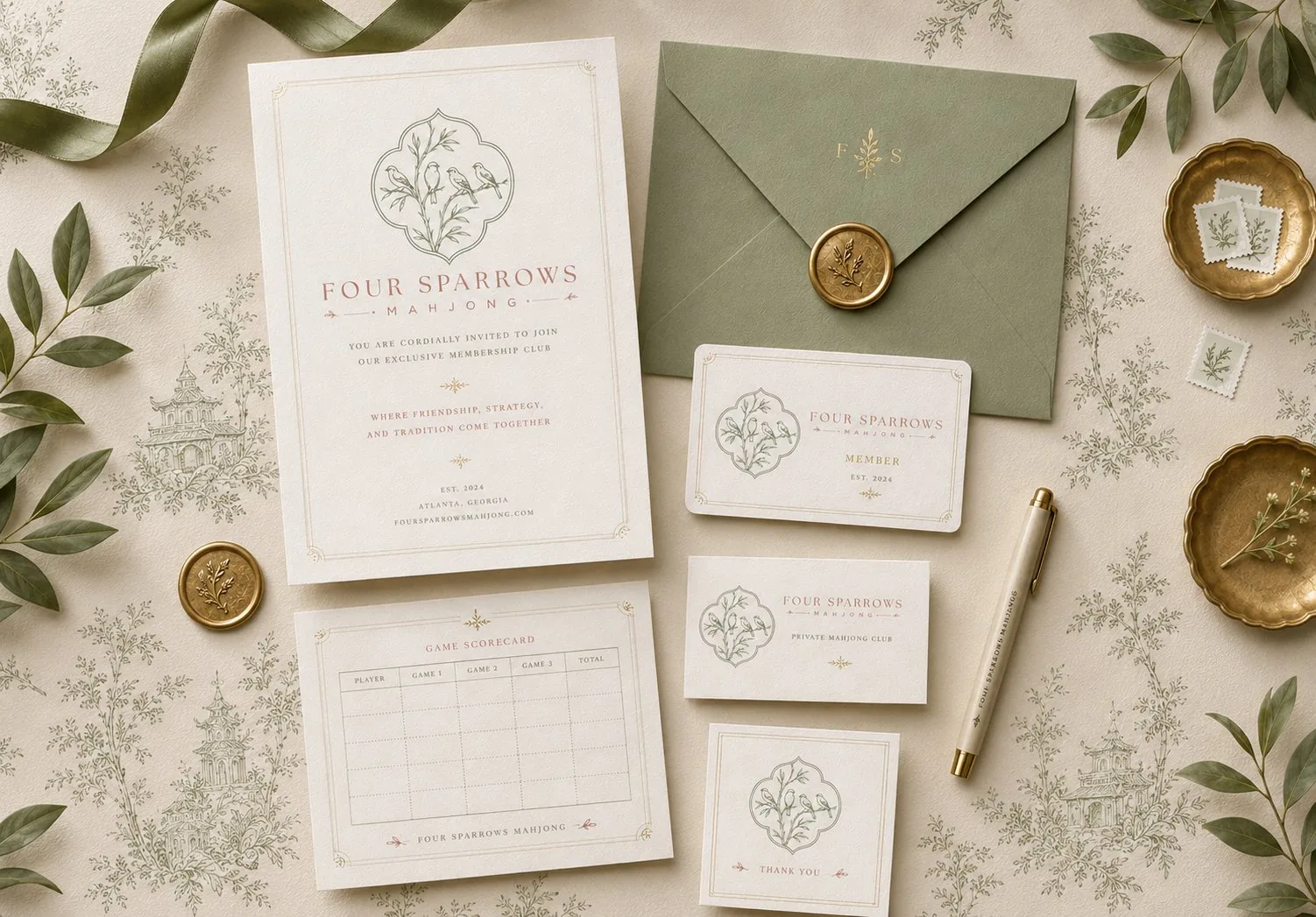
The Four Sparrows Mahjong identity is a reference from my own portfolio for carrying a themed identity into practical materials. It is a club identity rather than a civic emblem. The comparison concerns the relationship between a symbol and its supporting applications, not a claim that the briefs are interchangeable.
Let the identity system carry the rest
A place brand can use a family of images, an illustration approach, local language, and recurring layout relationships to express what the logo leaves out. That gives the place room to evolve without asking the symbol to represent every new event or audience.
The place heritage article addresses historical relevance. This guide focuses on the construction and hierarchy of layered meanings. In the logo design process, I would evaluate those meanings alongside recognition, production, and the business purpose before selecting a direction.
Frequently Asked Questions
Does a logo need a hidden meaning?
No. A clear, distinctive mark can work without one. A secondary meaning is useful only when it strengthens relevance or rewards attention without harming recognition.
Can a place identity represent every local story?
The full identity can carry many stories through imagery, language, and applications. The logo should prioritize a small number of clear, relevant ideas.
Sources and Credits
Sources checked and article updated on 13 October 2026. Reported examples are attributed above; frameworks and fictional scenarios are design recommendations. Portfolio examples are my own work and do not imply measured client outcomes.
Developing an identity rooted in a place or community? We can decide which meaning belongs in the mark and which stories need a wider visual system. Book a free consultation or explore design services.