
Choose mockups that show the business’s critical applications and expose the decisions behind them. Pair each image with its purpose, assumptions and next check so a founder can judge scope, practicality and priorities alongside visual appeal.
Start with the decision the image must support
A logo on a beautiful wall can help someone imagine a future business. It may say little about whether the identity works on the material that has to launch next month. Before commissioning a presentation, identify what the founder needs to decide: a creative direction, a production approach, a launch budget or a rollout priority.
I would choose mockups against those questions. A realistic front label might reveal how the product name fits. A mobile page might show whether the hierarchy supports a clear offer. A stationery family might demonstrate whether the identity has enough range for everyday use.
A reported example of early visualisation
Design Week: Asquith 1965 identity by OurCreative., 29 October 2026 reports that OurCreative. produced early in-context visualisations for Asquith 1965 and that these helped the team secure additional internal backing.
That is a specific reported project outcome. It does not establish that every showreel will unlock investment, or that a polished mockup proves the final object is ready for production. My recommendation is to make the assumptions visible so the image supports a useful discussion.
Select the smallest useful set
| Decision | Useful view | Assumption to expose |
|---|---|---|
| Creative direction | Several core applications together | The same real content is used |
| Product launch | Front, side and small online view | Dimensions and copy are representative |
| Digital rollout | A realistic mobile page or screen | Content length and behavior are defined |
| Physical presence | Sign or material in a relevant setting | Scale and construction need checking |
| Investment priority | Critical versus later applications | A visual is not a supplier quotation |
The purpose is to compare what matters. If one identity direction is shown on a premium embossed object and another on a flat screenshot, the presentation is also comparing production treatment. Use equivalent conditions when asking someone to choose between design routes.
Label what is real and what is proposed
State whether the content is final, whether the material has been sampled and whether the setting is illustrative. A rendered sign can establish a visual intention without confirming installation feasibility. A packaging view can show a design relationship without confirming a manufacturing specification.
For a fictional hospitality launch, a menu card and a booking page may answer more immediate questions than a branded vehicle. A later-phase application can still communicate ambition, provided it is identified as an extension rather than an item already included in the launch scope.
Use mockups to reveal weaknesses
Include a difficult application alongside the attractive hero view. Try a long name, a small label or a crowded partner layout. The aim is to discover where the system needs work before the presentation becomes a promise. A mockup that exposes a problem has done useful work.
Ask reviewers to distinguish their responses: does the direction fit the business, does the content make sense and what requires a practical check? Those are separate judgments. Recording them reduces the chance that an aesthetic preference becomes mistaken for production approval.
Connect the presentation to a delivery plan
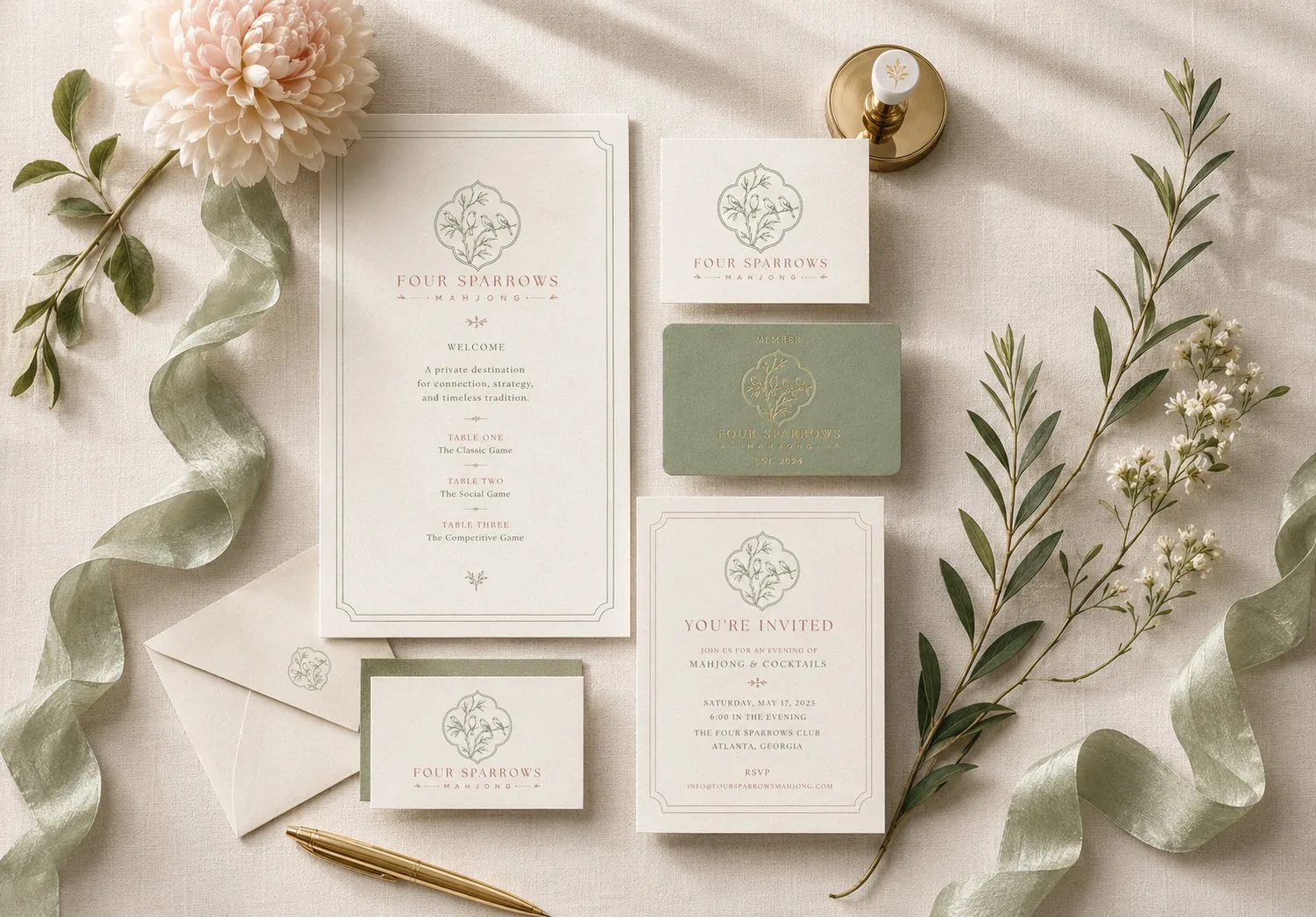
My Four Sparrows case study shows an identity across guest-facing materials. My Agent Inc. work demonstrates another family of business applications. They help explain how a visual direction can extend; they are not evidence of a fundraising result.
- Write the decision beside each selected application.
- Use realistic dimensions and content.
- Label illustrative settings and untested finishes.
- Include the application most likely to challenge the identity.
- List the supplier, content or implementation checks still required.
A useful brand identity presentation ends with an understandable next step. The founder should know what has been decided, what the images demonstrate and what still needs to become concrete.
Frequently Asked Questions
How many brand mockups should a presentation include?
Use enough to answer the actual decisions. A focused set of critical applications is more useful than a large collection of attractive scenes with no connection to the launch.
Does approving a mockup approve production?
Only if the project explicitly defines it that way and the necessary checks are complete. Record the scope of approval and keep untested dimensions, finishes and settings clearly identified.
Sources and Credits
Created and sources checked on 2 November 2026. The editorial date places this article in the requested series; it is not a claim of earlier publication. External projects are credited to their creators. The review frameworks and hypothetical examples are design recommendations, not measured client outcomes.
Bring the business decision, launch priorities and existing content. We can choose the applications that will make the identity proposal concrete and useful. Book a free consultation or explore design services.